 |
||
 |
|
|
 |
||||||||||||
 |
||||||||||||
 |
||||||||||||
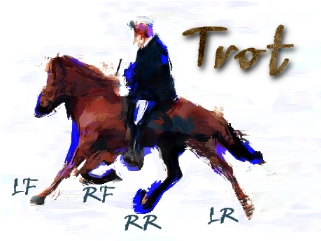
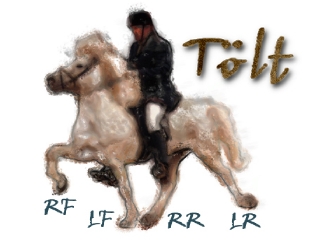
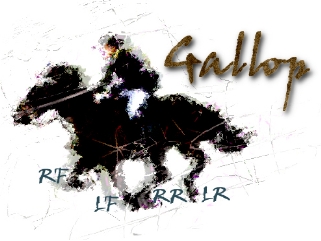
One of the main attractions of the Icelandic horse is its versatility. It is a naturally four or five-gaited horse, making it exceptional in comparison to other breeds. In addition to the three basic gaits, walk, trot, and canter, that all horses have, the Icelandic horse also offers tölt and pace. All the gaits of the Icelandic horse are natural to the breed, not produced by harsh training methods or any other artificial means. The WALK is a four-beat gait. The horse is relaxed, but moves ahead briskly, putting each foot down independently. A horse must have three feet (RF, LR, RR) on the ground and only one foot (LF) in the air at any time. The walking horse will lift first a hind leg, then the foreleg on the same side, then the opposite hind leg, then the remaining foreleg. This gait is very important in training, especially when preparing for tölt, because the feet move in the same way in the tölt as in the walk. The walk is also good to release tension and get the horse to work in a more focused manner. The TROT is a two-beat gait where the front and hind legs on the opposite sides of the horse move together. A foreleg (LF) and opposite hindleg (RR) touch the ground at the same time. In this gait, each leg bears weight separately, making it ideal to check for lameness or for stiffness in the joints. The trot is used a lot in basic training, before the horse has mastered the tölt. It is useful when working on the horse’s balance and teaching it to work with the rider. The TÖLT is the special gait of the Icelandic horse. It is a remarkably smooth, four-beat gait in which the horse moves its feet independently in the same order as the walk. When tölting, the horse’s legs move well under the body, enabling the back to soften and the forepart to rise. A beautiful tölter has high foreleg movement (RF) and carries its head in a dignified, free manner. The tölt can ridden at any speed from a slow tölt, where the horse’s tail waves up and down showing the rhythm of this remarkable gait, to the very fast tölt, where the fit Icelandic can easily keep up with a galloping horse. A favorite demonstration of the gait is the Beer Tölt, where riders hold a mug of beer at arm’s length while in tölt. The gait is so smooth that little is spilled. The GALLOP is a four-beat gait, ridden at various speeds. A slow gallop is comfortable for riding and common to all breeds. The two paired legs land separately, the hind leg (RR) landing slightly before the foreleg (LF). The gallop also involves having a leading leg. In turning at a very rapid rate, it is even more important that the horse use the appropriate lead, leading with the left leg if making a left turn, and the right leg if making a right turn, since the faster the turn the more the horse needs to lean into the turn. A fast gallop tends to liven up the horse, increasing its willingness and enthusiasm for work. Horses enjoy a good run now and then. The PACE is a lateral, two-beat gait, best known in the United States by pacers pulling a sulky in races. When pacing, the horse moves both legs on the same side together (LF, LR). Icelandics pace race for short distances with the rider mounted on the horse at speeds up to 35 miles an hour. No wonder it’s known as the “flying pace.” Riders sit to all five gaits which saves strain on their backs and knees. Due to a denser bone structure than other breeds, Icelandics can carry as much as three hundred pounds despite their relatively small size. |
||||||||||||
 |
||||||||||||
 |
||||||||||||
 |
||||||||||||
 |
||||||||||||
 |
||||||||||||
 |
||||||||||||
 |
||||||||||||
 |
||||||||||||
 |
||||||||||||
 |
||||||||||||
 |
||||||||||||
 |
||||||||||||
 |
||||||||||||
|
|
|
|
|
|
|
|
|
|
|
|
|
